The discovery was reported by a farmer riding his horse along a dirt road that very few know about and even fewer frequent. It was early morning, when the light still filtered obliquely through the trees and the humidity of the forest made the vegetation glow with that particular intensity of tropical areas after night. The man first saw the lingering smoke. Then the smell. And finally, when he got close enough to understand what he was seeing, he turned around and went to get a signal on his phone to make the call that would set in motion one of the most complex criminal investigations that the region’s authorities have faced in recent years.
What the first officers to arrive at the scene found left even veterans of the force speechless.
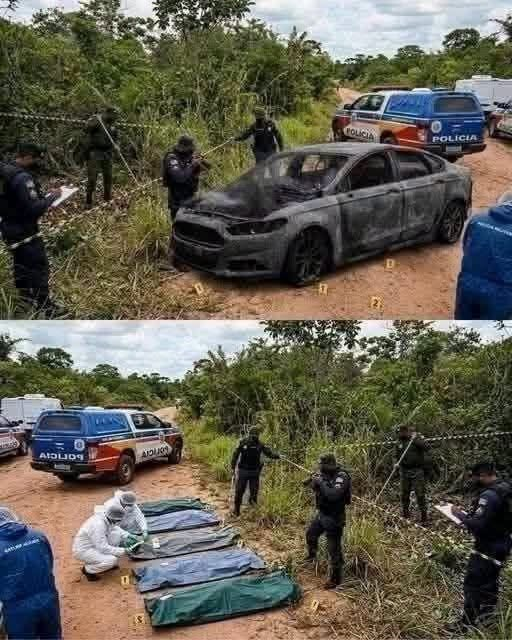
A completely burned-out vehicle, its dark color beneath the layer of soot covering every inch of its body, lay abandoned on the side of the dirt road, bearing the clear marks of having been deliberately and systematically set on fire. And a few meters away, four bodies wrapped in green tarpaulins, aligned with a precision that investigators immediately interpreted as a signature, a message, the kind of staging that doesn’t happen by accident but requires planning and communicates something specific to those who know how to read that language.
The crime scene
Inspector Rodrigo Vasconcelos, head of the homicide unit that took over the case, described the scene at a press conference as one of the most elaborate he has processed in his eighteen- year career.
“We are dealing with a multiple execution with all the hallmarks of organized crime . The way the bodies were arranged, the burning of the vehicle as a method of eliminating evidence, the choice of location: everything indicates prior planning and experience in this type of operation,” the inspector stated without going into specific details that could compromise the ongoing investigation.
The forensic team deployed at the scene worked for more than six hours collecting evidence. The forensic experts , identifiable by their white protective suits, moved meticulously around the bodies and the vehicle, placing yellow evidence markers that dotted the red dirt floor, creating that characteristic image of crime scenes that later circulates in the media and that the public has learned to recognize without fully understanding what they represent.
Each marker pointed to something. A shell casing. A fragment. A footprint. The material trace of what had happened on that road that no one usually travels.
The vehicle, according to a preliminary assessment by technicians , was a mid-range sedan that had been set on fire with an accelerant. The fire had destroyed most of the elements that could have facilitated quick identification: the license plates were illegible, the interior was completely charred, and the chassis identification numbers would require laboratory analysis to recover. Someone knew exactly what they were destroying.
The victims
The identities of the four deceased were not publicly confirmed in the initial hours of the investigation. Authorities requested time to complete the identification process, which in cases like this requires detailed forensic analysis given the condition in which the bodies were found.
What did emerge, through sources close to the investigation who requested anonymity, is that the initial evidence suggests that the four victims were men between twenty and forty years old, and that at least two of them had criminal records related to drug trafficking activities in the region.
This information, although not officially confirmed, immediately fueled the theories that investigators had been considering since processing the scene: a settling of scores between rival factions, a territorial dispute for control of distribution routes, or an internal disciplinary action within one of the criminal organizations operating in the area.
“In these types of cases, the way the scene is presented almost always communicates something,” explained an experienced investigator off the record who has worked on similar cases in other regions. “Four bodies lined up, wrapped in that way, in a place specifically chosen to be found but not immediately: that ’s not just a disposal. It’s a warning.”
Who is that warning directed at? That is precisely one of the lines of investigation that the authorities are following most closely.
The regional context
The road where the bodies were found is located in an area that law enforcement agencies have identified for several years as a transit corridor for drug trafficking organizations and other cross-border crimes . The dense vegetation, lack of artificial lighting, scarcity of potential witnesses, and distance from urban centers make these rural roads the preferred setting for this type of crime.
Over the past eighteen months, the region has seen a sustained increase in organized crime- related violence . Security analysts attribute this rise to a reconfiguration of routes and territories following the partial dismantling of several networks that operated more stably in previous years. When a criminal structure collapses or weakens, the resulting power vacuum doesn’t remain empty: it is contested, and this contestation comes at a cost in human lives, generally falling on the lowest and most expendable links in the criminal chain.
The four men found on that red dirt road could be part of that statistic. Or they could be something more complex. The investigation still has no definitive answers.
The rural community and the silence
In the communities near the site of the discovery, the predominant reaction was silence.
Not indifference, which is something else entirely. The conscious and deliberate silence of those who have learned that in certain contexts speaking out comes at too high a price. The journalists who arrived in the area on the afternoon of the same day as the discovery found closed doors, monosyllabic answers , and glances that quickly averted themselves with the practiced speed of someone who knows that prolonged eye contact can be interpreted as a willingness to provide information.
An elderly woman who agreed to speak briefly from her doorstep, without giving her name and expressly requesting that her home not be described , summed up the general feeling in a few words.
“You see and you don’t see. You know and you don’t know. That’s how life is here.”
Then she closed the door gently but firmly, and never opened it again.
The farmer who made the original discovery and alerted the authorities was preventively moved to a safe place by the investigators themselves, a measure that speaks volumes about the assessment that the authorities make of the real risk in the area.
The vehicle as key evidence
Forensic technicians have placed much of their investigative hope on analyzing the burned-out vehicle. Despite the destruction caused by the fire, specialized laboratories have techniques that allow them to recover identification numbers engraved on the chassis even after exposure to extreme temperatures, using chemical procedures that reveal the original markings on the metal.
If the vehicle can be identified, that identification will open a line of investigation that could lead to its registered owners, those who acquired it, and potentially those who used it the night the executions occurred.