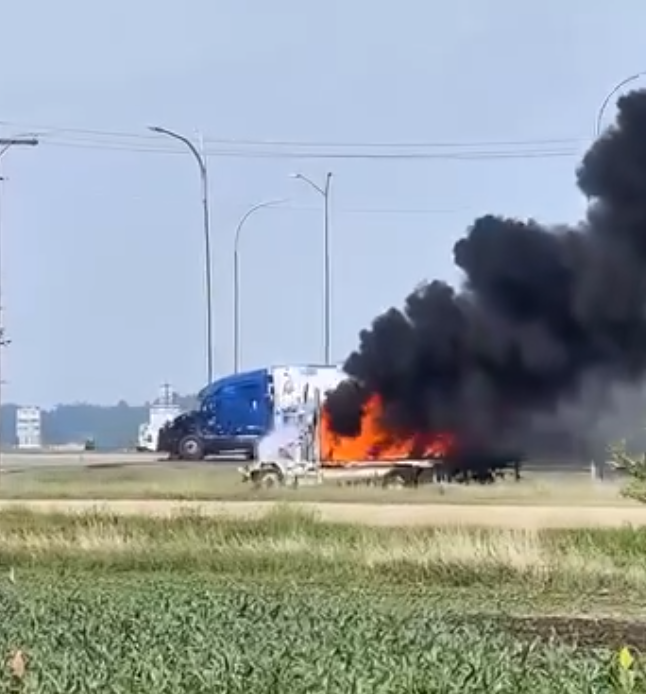
The visual reality of the scene only underscores the sheer violence of the impact. Thick, pitch-black smoke billows high into the clear prairie sky, visible from miles away as a grim marker of the disaster. At the heart of the chaos, bright orange flames consume what remains of the vehicle on the side of the highway. The fire rages intensely, leaving behind a charred, unrecognizable frame. Nearby, a large blue semi-truck stands halted on the roadway, its presence a stark testament to the collision that just occurred. First responders and emergency vehicles have arrived, their flashing lights cutting through the haze as personnel begin the grim task of securing the area. Traffic on the trans-Canada route has ground to a complete standstill while emergency crews work frantically.
The community of Dauphin, from where many of the elderly passengers originated, has been plunged into a state of absolute shock. Neighbors are gathering in local community centers, weeping openly as they wait for official confirmation of names. This tragedy has ripped a hole through the fabric of a tight-knit senior community that spent years building up the region. Flags across Manitoba are being lowered to half-mast as a symbol of collective provincial mourning. Prime Minister Justin Trudeau and Premier Heather Stefanson have both issued statements expressing deep heartbreak over the unimaginable loss. Counselors and mental health support teams are being deployed to assist the families navigating this sudden, devastating grief.
In the days ahead, the investigation will pivot to the mechanical integrity of the vehicles involved. Forensic collision reconstructionists are meticulously mapping out the tire tracks and debris scattered across the asphalt. Every piece of data, from the truck’s electronic logging device to potential dashcam footage from passing motorists, will be scrutinized. Questions are already being raised by local residents regarding the safety history of this specific intersection. Highway safety advocates are urging immediate government action to implement better signaling or a grade-separated interchange. The economic cost of the crash is secondary to the priceless lives that were abruptly extinguished on that stretch of road.
As evening falls, the smoke finally begins to clear, revealing the stark, blackened scar left on the Manitoba landscape. The physical wreckage will eventually be cleared away, but the emotional trauma will linger for generations. Memorial services are being planned across the province to honor the victims who perished so suddenly. This intersection near Carberry will no longer just be a point on a map, but a place of profound remembrance. The resilience of the people of Manitoba will be tested thoroughly in the painful weeks of funerals and healing ahead. For now, a heavy silence hangs over the cornfields surrounding the crash site, interrupted only by the distant hum of remaining emergency vehicles.