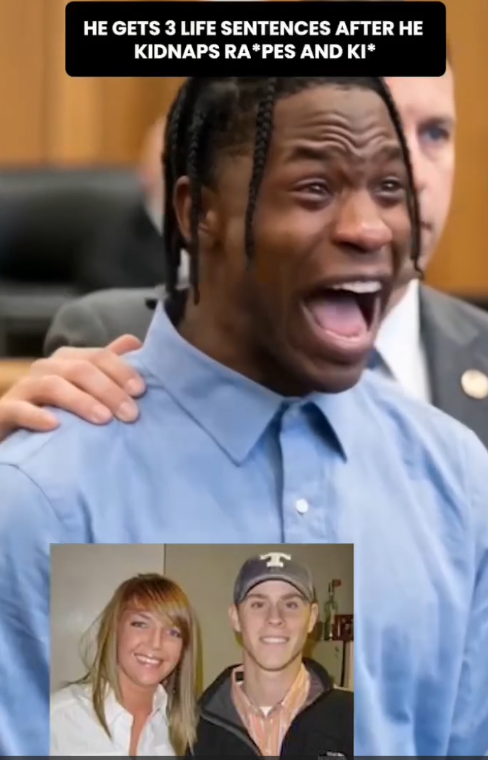
The video clip presents a dramatic and emotionally charged courtroom setting that immediately captures the viewer’s attention. At the center of the frame stands a young Black man dressed in a light blue, button-down dress shirt. His hair is neatly styled in short braids that frame his face as he listens intently. A Caucasian man in a dark suit stands directly behind him, resting a reassuring hand on the defendant’s shoulder. The defendant’s facial features appear to be altered or enhanced using artificial intelligence to mimic a well-known public figure. His expression is initially solemn, marked by deep sadness and wet tears glistening on his cheeks. Across the top of the video, a bold text overlay reads a highly sensationalized criminal headline. The text claims that the individual is receiving three consecutive life sentences for severe offenses. Specifically, the overlay uses censored terms to describe allegations of kidnapping, sexual assault, and murder. In the bottom corner of the video, a smaller inset photograph displays a smiling young couple. The blonde woman and the young man in a baseball cap in the photo appear happy and completely oblivious to the surrounding legal drama. This contrast between the cheerful archival photograph and the somber courtroom environment creates a jarring visual juxtaposition. The camera remains tightly focused on the defendant as the weight of the moment builds up. Every detail of the scene is designed to evoke a strong emotional reaction from the audience watching online. The lighting in the courtroom is bright and sterile, typical of a standard legal proceeding. The background shows blurred figures of other individuals present in the gallery or legal team. The video relies heavily on visual storytelling to convey a narrative of severe legal judgment and personal ruin. Viewers are immediately drawn into the unfolding crisis without any initial context or background information. The digital manipulation of the main subject’s face is subtly noticeable upon closer inspection. Such video edits frequently circulate on social media platforms to generate clicks and engagement through shock value. The composition places the alleged perpetrator and the victims in the same visual space to tell a specific story. This structural layout makes the viewer process multiple pieces of emotional information simultaneously. The text block remains static throughout the short duration of the digital clip. It serves as the primary narrative driver for anyone watching the video without sound. The overall aesthetic mimics a modern true-crime documentary snippet tailored for short-form video applications.
As the audio plays, a stern voice representing the presiding judge delivers the final legal pronouncement. The judge clearly states that the defendant is officially sentenced to three life sentences. Upon hearing these devastating words, the man’s stoic composure completely shatters in an instant. He gasps for air as his face contorts into an expression of pure agonizing disbelief. He then unleashes a loud, despondent scream, shouting “NOOOOO!” directly toward the front of the courtroom. His body tenses up as he tilts his head back in sheer desperation and profound grief. The man behind him maintains a firm grip on his shoulder, attempting to provide stability during the emotional collapse. This sudden outburst amplifies the dramatic tension of the brief video segment significantly. The raw pain in the vocalization contrasts sharply with the formal atmosphere of the legal institution. However, it is crucial to recognize that this entire sequence is an engineered piece of digital fiction. The audio track and the visual performance are synchronized to simulate an authentic high-stakes courtroom reaction. In reality, the inset photograph depicts Channon Christian and Christopher Newsom, who were victims of a tragic 2007 crime. The real-world case involving those victims has absolutely no connection to the individual shown in the video. The actual perpetrators of that historic crime were tried and sentenced decades before this video was created. Using their likeness in this manner exploits a real tragedy for internet attention and digital traffic. Many viewers might easily mistake this highly realistic AI manipulation for a genuine news report. It highlights the growing challenges of identifying misinformation in the age of advanced digital editing tools. The video ends abruptly right after the intense emotional climax of the defendant’s vocal scream. This leaves the audience with a lingering sense of shock and unanswered questions about the case. Content creators often use these open-ended, dramatic clips to encourage comments and debates in the video’s section. Analyzing such media requires a critical eye to separate synthetic fabrications from genuine historical facts. The clip serves as a powerful example of how digital media can distort reality by mixing unrelated elements. By combining real victims’ photos with fake AI avatars, the video constructs an entirely fabricated true-crime mythos. Understanding the true origin of the photos honors the memory of the real individuals involved. Ultimately, the piece stands as a cautionary reminder of the pervasive nature of viral internet hoaxes.