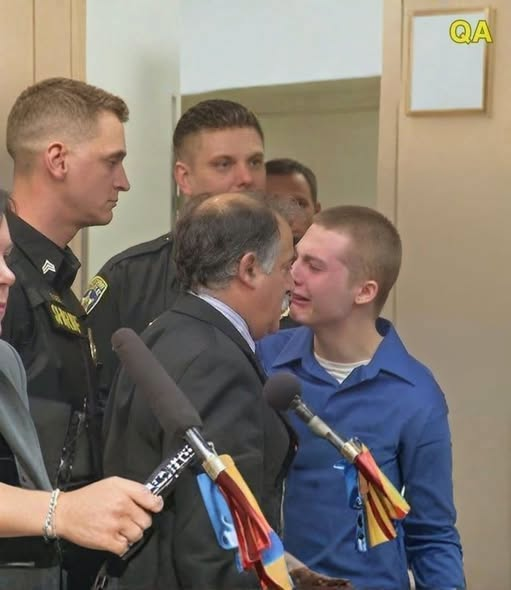
The gavel dropped and the room stopped breathing. A teenager was just sentenced to 452 years in prison, as victims wept and a nation watched in stunned silence. Is this justice, or a legal system lashing out in fear? As outrage collides with relief, one haunting question refuses to fade: when does punishment become something else entirely?
The judge’s words echoed long after the courtroom fell quiet. No one moved for several seconds. Some people lowered their heads, while others stared forward, trying to process the weight of the decision. Reporters rushed to file breaking stories. Television cameras captured every expression, every tear, and every whispered conversation. Outside the courthouse, crowds had already gathered behind barricades. Some applauded the sentence, believing it represented accountability. Others stood in silence, unsure whether they had just witnessed justice or history repeating itself in another form. Social media quickly filled with passionate opinions from every side. Within hours, the case had become one of the most debated legal decisions in the country. What happened inside that courtroom was no longer just a local case—it had become part of a much larger national conversation.
In the days after the sentence, the country split along a raw, jagged line. For the victims and their families, the ruling felt like the first moment the legal system truly saw them. Their stories of terror and loss echoed through the courtroom, and for many, 452 years still seemed too small a container for what had been taken. The sentence became a promise: this will never happen again, not from him.
Many families described the verdict as the beginning of a long process of healing rather than the end of their pain. They spoke about years of fear, sleepless nights, and memories that refused to fade. Community leaders expressed hope that the outcome would reassure other victims that their voices mattered. At the same time, public demonstrations appeared in several cities. Some participants carried signs demanding stronger protection for victims. Others called for a justice system that recognized both accountability and the possibility of change. Universities hosted public discussions. Law schools organized debates. Religious organizations opened their doors for community conversations. Across the country, people who rarely discussed criminal justice suddenly found themselves asking difficult questions about responsibility, forgiveness, and the purpose of punishment.
Yet outside the courthouse, another story gathered force. Advocates, scholars, and ordinary citizens asked what it means to condemn a teenager to die behind bars. Neuroscientists reminded us that adolescent brains are still under construction; faith leaders spoke of redemption; legal experts warned of a system that confuses finality with fairness. In the end, this case did more than punish one young offender. It exposed a nation still undecided on whether justice is about who we fear, or who we choose to become.
The discussion continued long after the headlines began to fade. Editorials offered sharply different perspectives. Former judges reflected on how similar cases had shaped the law over the decades. Psychologists emphasized the importance of understanding youth development without minimizing the seriousness of violent crime. Victim advocates insisted that compassion for offenders should never erase compassion for those who suffered. Others argued that true justice should leave room for growth, even in the darkest cases. The teenager at the center of the case became more than an individual defendant; he became a symbol in a debate that reached far beyond one courtroom. Years from now, people may remember the sentence itself, but they may also remember the questions it forced society to confront. Those questions remain unanswered, continuing to challenge lawmakers, communities, and future generations to define what justice should truly mean.